
|Penny Folger|
Testament plays at the Trylon Cinema on Wednesday, June 3. For tickets, showtimes, and other series information, visit trylon.org.
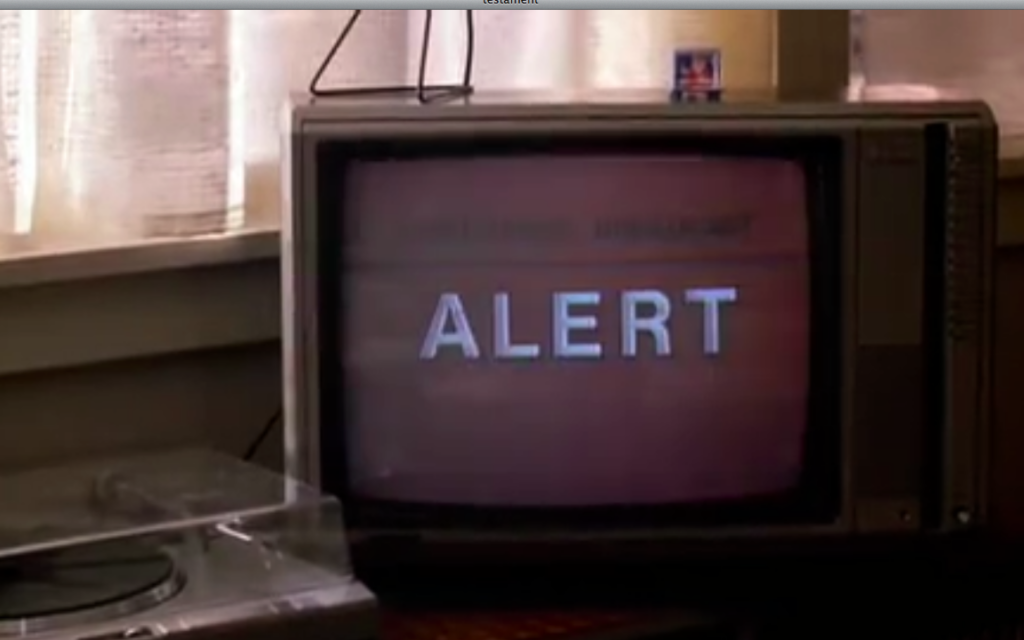
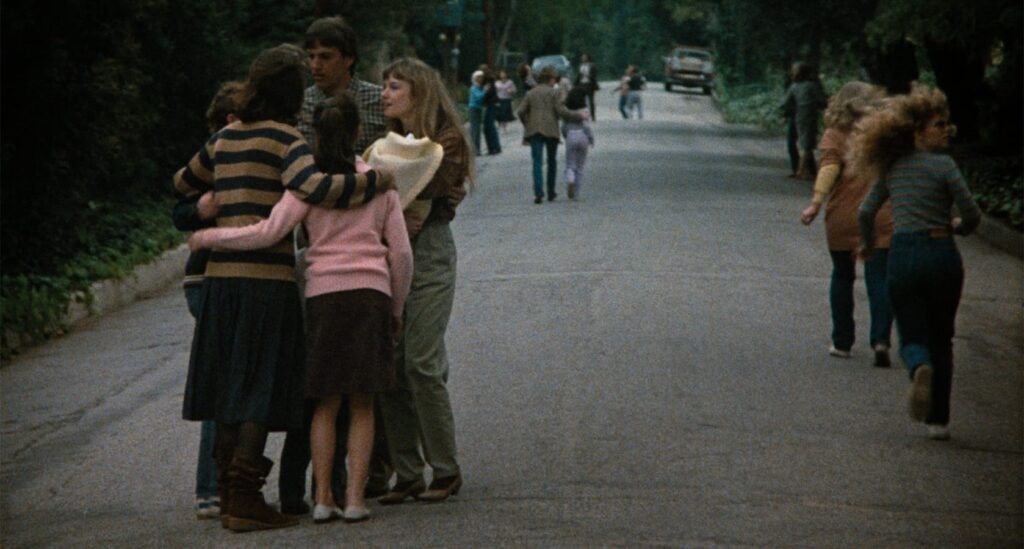
Bleak Week, which began at the American Cinematheque in 2022, partially as an ironic response to the pandemic, has now spread globally and is making its triumphant return to Trylon Cinema. This time with Testament, the story of a family in a small town on the outskirts of San Francisco in the aftermath of a nuclear holocaust. It’s a holocaust happening in the United States anyway—it appears to have at least wiped out the major cities in California and down the Eastern seaboard. (We’re never actually told what’s become of the Midwest.) Small towns in rural areas have survived the initial blast, at least for the moment, only suffering progressive casualties in the weeks to come with the aftereffects of radiation that embody the film frame and our story. Yet because this is an intimate portrait of a family and the technologies of the day have all gone kaput, we’re never actually given larger details regarding nations and wars and who is to blame. All that is irrelevant, as this story is more personal: it’s about its impact on a small town and a family.
The intimacy of this story feels intentional. This film was directed by a woman, Lynne Littman, and based on another woman’s, Carol Amen’s, short story. You can almost viscerally feel that this project was created from the anxieties of being a parent, in this case, a mother. Agrees its star, Jane Alexander, “It had a very strong maternal aspect to it.”1 Explained Littman, “We had worked out a sort of emotional map for Testament.”2 One wonders if someone like Jerry Bruckheimer or James Cameron would use phrases like “emotional map,” though this is a very different movie than one that might be helmed by either of those men.
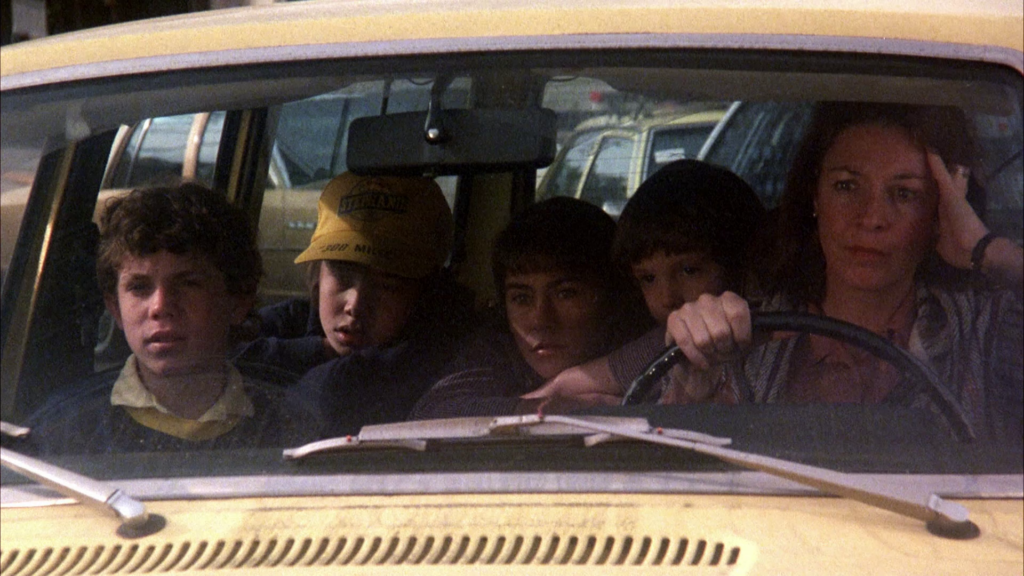
Alexander plays Carol, the mother and protagonist of the film, who struggles to keep her family going when their daily lives have collided with radiation poisoning and a town whose infrastructure is crumbling. As Alexander reminisced to Littman, “You turned to me and said, ‘Oh my gosh, this is a film about sheets. It’s a woman’s understanding of what we deal with on a daily basis.’”3
Amen conceived this story from her own personal nightmares. Explains Littman, “She woke up in the middle of the night, had this dream, got out of bed, wrote this whole story down and went back to sleep.”4 The movie feels exactly like the kind of nightmare a parent would have, particularly during the Cold War of the early 1980s. It taps into deep-seated fears about destructive global affairs beyond one’s control and being unable to keep your children safe. In the aftermath of a nuclear holocaust, the landscape, the food, the water is unsafe, and children are among the most vulnerable, yet a parent is powerless to protect them. Says Littman, “The story reads like a dream. It reads like something that rushed out of somebody. It was clearly her nightmare. It certainly was mine, and Jane Alexander talked about the fact that it was her nightmare.”5
Even the late John Sacret Young, who adapted Amen’s short story into a screenplay, admits that being a parent influenced his ability to write the material. “The details were probably small and spare that came literally from my children. But I think around them were emotions that I would not have known, and that I therefore could not have conveyed.”6
Parental nightmare fuel aside, the inequalities of being a mother are illustrated in this film long before the blast hits. Carol’s husband Tom, played by William Devane, has the time to ride his bike after taking their oldest son out briefly one morning, while Carol stays at home, feeds three kids, drags them out the door, takes out the trash, and heads out to direct the school play. This certainly still happens in our modern day, but was this kind of gender-based labor imbalance even more prevalent in 1983, a decade that was only 30 years removed from the 1950s? Probably. You keep waiting for Carol to openly complain but instead she worries to her husband late at night about a children’s birthday present that is not needed for two months. Is, “You don’t do anything” in the subtext?
Littman began her career as a public television journalist and later as a documentary filmmaker, and her documentary sensibilities lend themselves well to this material and its low budget. Amen’s story was published in Ms. Magazine in 1981, and Littman used her investigative journalism skills to track Amen down by telephone in order to get the rights. Upon initial viewing I expected to see the special effects and carnage of a direct blast, but what is portrayed here is more akin to emotional violence in its silence. Jane staring hollowly in the face of death, yet still fighting to persevere.
There’s an overt metaphor in the movie provided by Young’s screenplay that was not in Amen’s original short story. He sets it in the fictional town of Hamelin, California. Not coincidentally, Carol is directing a school production of The Pied Piper of Hamelin, which is still put on, post-blast, amidst tears from parents in the audience. (Little do they know the mortality rate that is yet to come.) The play about a town whose children are taken away was also used as a metaphor in Atom Egoyan’s The Sweet Hereafter, a prior Bleak Week screening, about a school bus that goes down in a small town with children still inside.
The film has tiny moments of solace and humanity amidst the darkness, such as when Carol and her eldest son dance to a tinny recording of the Beatles in their darkened living room. One haunting quality in the film is its flashbacks of family home movies in happier, non-radiation-filled times, which were shot with handheld Super 8. Some of those clips mirror this scene, with Carol and her children silently dancing in the clean air and the green grass that has since turned brown.
Said Littman, “The whole film is up and down, life and death. That’s what it is emotionally. How to make the death tolerable by making the life good enough. Life on the edge of death.”7 Pointed out interviewer and film historian Sam Wasson to Littman, “If you were to think about pitching Testament to a studio, it’s like a joke.”8
Testament co-stars several young actors who would go on to become more famous. Lukas Haas would appear in Witness with Harrison Ford two years later, and Tim Burton’s Mars Attacks. Testament was also one of Rebecca De Mornay’s first films, released the same year as Risky Business, which put her on the map. Her husband is played by a young Kevin Costner, who in 1983 was not yet known for much of anything, other than perhaps famously being cut out of The Big Chill, released the same year. (I imagine his exclusion only became well-known once he was actually famous.)
Devane, one of the more seasoned actors on set, is less prevalent in the film than Alexander. Through no fault of his own—it’s an aftereffect of the story structure—it’s still funnily symbolic. A dad who does less in a household helmed by his wife is no longer physically around when things get rough. This is a situation that happens even when it’s not at the hands of an atomic bomb and there’s something in the perspective of its authors that seems to be rendering this intentionally.
According to Littman, Devane was difficult to work with. This culminated in an incident where he was reportedly hiding in an upstairs bedroom on the set in his underwear! Littman finally went off on him. “Why are you doing this to me? Why are you giving me such a rough time? You’ve been on 400 more sets than I have. You have much more experience than I have. But I know about this script better than you ever will.”9
Unruly male leads, and future star power aside, Testament rides on the shoulders of Alexander, who seems to be channeling the perspective of the woman who wrote, or rather dreamt it. The character and its author, who later died of cancer, even share the same first name. The movie is Amen’s and Alexander’s. It’s the mothers’ who survived the Cold War in American suburbia. It’s for those who ran households or lived with absentee or unhelpful partners, surrounded by endless loads of laundry and endless detergent commercials running on daytime broadcast television. It’s for Littman, who started a career as a reporter in public television at a time when this was considered “unimportant” enough that women were actually granted access. It’s for every parent who’s had to raise a child in a dangerous and potentially fatal world.
Notes:
- Lynne Littman, director. Testament at 20. 2003. ↩︎
- Lynne Littman, interview by Sam Wasson, The Criterion Collection, 2025. ↩︎
- Lynne Littman, director. Testament at 20. 2003. ↩︎
- Lynne Littman, director. Testament at 20. 2003. ↩︎
- Lynne Littman, director. Testament at 20. 2003. ↩︎
- Lynne Littman, director. Testament at 20. 2003. ↩︎
- Lynne Littman, interview by Sam Wasson, The Criterion Collection, 2025. ↩︎
- Lynne Littman, interview by Sam Wasson, The Criterion Collection, 2025. ↩︎
- Lynne Littman, director. Testament at 20. 2003. ↩︎
Edited by Finn Odum