
|Sophie Durbin|
Sátántangó plays at the Trylon Cinema as part of BLEAK WEEK on Saturday, June 6. One show only! For tickets, showtimes, and other series information, visit trylon.org.
“Regard me as a sad researcher who investigates why everything is as terrible as it is.”(Irimiás, but he could be describing me!)
Eager to celebrate Bleak Week, my favorite national holiday, I asked humbly to write about Sátántangó. My intentions were noble. I wanted to do a “Slow Looking” analysis in which I muse about the benefits of immersing oneself in the world of a film over many hours and how it can enact a meditative state, etc., etc. Once I entered the month of May and an insanely busy season in my life, I realized this was an overly ambitious plan and adjusted accordingly: I would watch the film about an hour a day for a week, and do my best to document the journey.
What follows is my disjointed captain’s log from a series of viewings through which I cobbled together my own experience of Béla Tarr’s masterpiece, which was never meant to be watched in such a fragmented way. Please, go see it in its 7.5 hour glory at the Trylon, as Tarr would have wanted you to, and don’t follow my example.
5/4/26
Woke up at 3:45 am to catch a work flight to the Chicago suburbs for a 1-day business trip. Ended the day with surprisingly good tapas, spicy margarita, Albarino at a rooftop Spanish restaurant at a semi-ritzy hotel overlooking a mall. Turned on the archive.org upload of Sátántangó for lack of better options, planning to watch 1 hour (procrastinated first reading a Reddit thread about how real film lovers need to watch the whole thing in one sitting, felt guilty). Fell asleep 17 minutes in and missed 75% of the minimal dialogue I heard. Was riveted by the cows but figured I should call it a night.
5/5/26
Picked up where I left off and got sleepy again by 32:15. The sound is mesmerizing. I’m a big fan of ASMR and so far the film is like one long grotesque ASMR video, where every paper bill, every articulated “t,” every tick of the clock is delicate and crisp. The Hungarian language lends itself well to this, with all its “sz” sounds and its 17-part case system which modifies words ever just so slightly so that you’re hearing a dizzyingly varied patter of phonemes at any given time. At 39:38 I had to acknowledge that I was getting nowhere. This is not the fault of the film, which is compelling so far when I’ve been able to stay awake.
5/8/26
Sat down at 7:46 pm to pick the film back up on a Friday night, watching on an actual TV. Made it to 2:11, “The Spider’s Work.” The greyness is so rich that it feels like an accurate depiction of how grey a grey day can really be; the sound, how it weaves! When the Doctor is staggering towards the lit house in the night, and we can faintly hear accordion folk music playing, and I can’t believe he’s alive…I made it to 3:25, after I’d had enough animal cruelty for the night.
Every single moment of these peoples’ existence seems to be nothing but misery and apathy. On the cat torture, I admit I looked away and waited it out. I picked up my phone and violated the Slow Looking ethos of my pitch because I didn’t want to see an animal being hurt. All respect to Tarr, and I wouldn’t censor that part of the film or anything, but I can’t really take part.
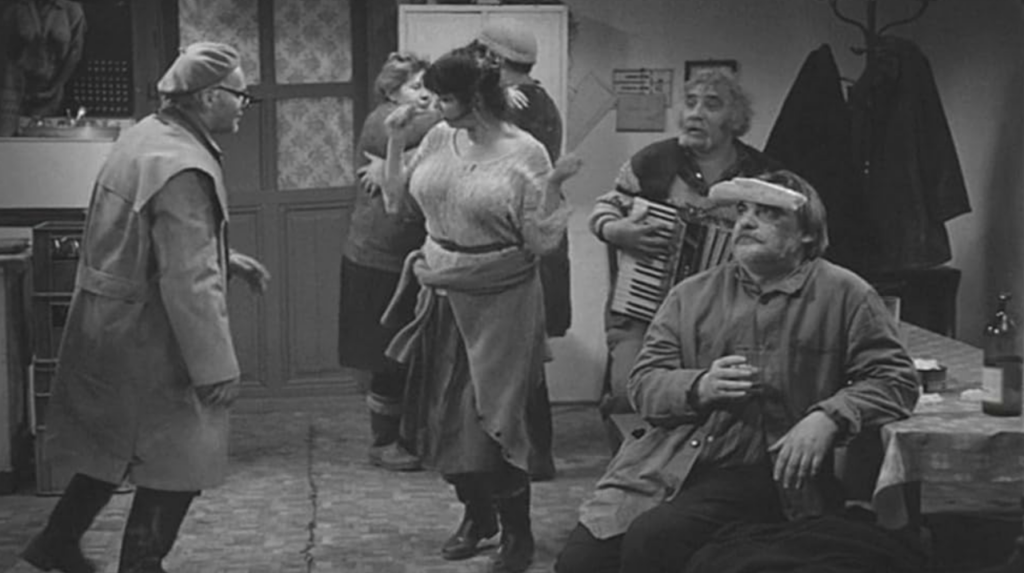
Damn, that dance sequence!!! Those people are going insane! Everyone can find joy in life with enough moonshine even if you are living in a dying hamlet in the middle of nowhere.
5/9/26
Almost near the finish line: made it to 5:50. I did drift off in a few spots, as I will now admit I did last night. (Movie-watching bad behavior I tend to partake in: I fall asleep a lot, my mind wanders, and I lose track of plots.)
The extended, second polka sequence is just stellar: we start by hearing that sea captain looking guy (sorry, using a placeholder name for now) rattling on about explosives and gunpowder and his voice is like a drill to the head. Eventually we finally see the dancing from inside and the intricacy of this sequence and the complexity of how it all (d)evolves is wild…Mrs. Schmidt (?) is hesitant at first, then repelled, then eventually falls wholeheartedly into the dancing, while the others participate in their own weird, nonlinear ways.
I felt only relieved when they cut to the villagers huddled around Estike’s dead body. She tortured and killed a cat and made us watch!! That said, I suppose she probably tortured it in this very peculiar way (“I’m stronger than you…” “You can’t beat me…” and wrestling with it like it was a tiny human) because she was mirroring how she’d been treated by her brother, it’s not like child welfare is a likely priority around these parts. So I guess Estike’s cruelty is really meant to be another tragedy in and of itself.
5/10/26
Phew, I finished it, though once again I drifted off for a few minutes in the middle of my final viewing. Archive.org shat the bed at a certain point and I had to do emergency recon to figure out where else to watch it, since Criterion isn’t currently streaming its version…I found what I needed through Kanopy, which is connected to my Hennepin County Library account and appears to give me 15 “tickets” worth of free streaming films a month. Go check out Kanopy, library goers!
I did have a fondness for the Doctor, and how he is somehow quite spry despite being a Leaving Las Vegas level alcoholic of staggering size. His willingness to take any kind of independent action is admirable among the villagers; his constant notetaking must be a holdover from his old career, his way of still feeling useful. So ending the film with him felt comforting, despite the fact that he boards up his house from the inside so that he can drink himself to death in the dark as the autumn rains blow in. The sequence where he is drawn to the ruined chapel where the crazy guy is tolling the bell while relentlessly shouting “THE TURKS ARE COMING” was something else. Reminding myself to refresh myself on my Hungary/Turkiye history…
As I wrap my week’s worth of Sátántangó viewing, I’d love to say that my primary insights are about the film, but really they’re about how Béla Tarr made this film to be an experience, which one must carve out time for. There is no stealing away to quickly watch Sátántangó, no skimming on double-speed or whatever other weird hacks one can imagine. Watching it in one go is a luxury completely incompatible with the grind of contemporary existence, which has me (and everyone I know) frantically navigating work and life and feeling like a failure for never being able to 100% satisfy our responsibilities to either. To those of you who make it to the Trylon for the whole show: savor the experience. It is a gift. Buy a box of Dots, nestle into your seat, struggle with the bafflingly slow shots and the pounding, plodding repetition and the eerie accordion score, and when your mind begins to wander or you feel yourself start to drift, guide your attention back to the slow journey in front of you.
Edited by Olga Tchepikova-Treon