
|Matthew Tchepikova-Treon|
Horrorthon X happens in three iterations at the Trylon Cinema Friday, October 9 and Saturday, October 10. For tickets and other series information, visit trylon.org.
In the fall of 2023, I suffered my first ever bike accident as an adult (though I’d experienced plenty as a kid, largely due to a general lack of self-regard for my body flying off dirt ramps, across alleyways, and through dark wooded terrain). In fact, I suffered three accidents in a matter of weeks, one of which was particularly horrific.
Scene 1: Biking to the UMN campus where I teach, crossing Franklin Ave. Bridge, I was so enamored by the blade-like tines of early-morning sunlight piercing the autumnal trees along the river that I didn’t see a thin layer of frost on the ground in front of me. I stood up on my bike pedals, eyes to the sky, and slightly shifted my balance to turn. Then, heavy with weightlessness, the bike no longer underneath me, the abrupt shock of realization—I’m not going to be able to stop this from happening—followed by waiting for the inevitable seemed to happen both instantly and in slow motion. Then concrete.
Scene 2: Mere days later, I was biking down a busy street. With snow starting to accumulate, parked cars were being pushed closer and closer into the bike lane. Moving at probably 20 or 25 MPHs, with busy traffic on my left, I only noticed the silver Ford Escape to my right when its front door opened. I’ve often imagined what that moment was like for the driver. She must’ve heard the crunching sound first, when the edge of her door caught me square in the shoulder, then felt the door ripped from her hand as she watched a corkscrewing body fly past her window. No slow motion this time. Instant pain, then concrete, then waiting for a car to run me over (which thankfully braked just in time).
Scene 3 (less horrific but weirder): Biking home from work, about to cross Lake Street Bridge, I was turning right while going up a slight incline when my left crank shaft (the steel, seemingly indestructible bar that connects the pedal to the drivetrain) snapped. It would be a few seconds before I could deduce that this is what actually happened. First, I had to be violently thrown feet-over-head into the air and slammed onto my back with the bike somehow landing on top of me. Once again on the concrete, this time the physical experience was so inexplicable that it felt like time had momentarily moved in reverse. What was I doing on the ground? How did I completely flip over my handlebars? Why had my bike just Ric Flair-ed my ass with a vertical suplex? What had happened was, with all of my momentum churning downward on one side of the bike while turning the front wheel in the opposite direction, once the crank shaft snapped, my weight and momentum never came back up, never transferred to the other foot/pedal, and I fell victim to the sudden angular acceleration of gravitational torque; or, τ = F × r × sin(θ), where θ is the angle between the force vector and the lever arm thereof.
At this point I want to assure you that this is indeed a short essay about music in horror movies. The title is not a mistake.
Aside from varying degrees of pain, my sense memories from each bike wreck mostly involve the way time felt: the fear of anticipation, the shock of sudden horror, the distress of chaos and confusion. In other words, the violent accidents detailed above represent, to me, analogues for the sensation of dread experienced in a truly scary film, those primal moments of tension and release that can compel you to reflexively shout, “Oh fuck!” right before the horrific happens. It’s the unique high I know I’m always chasing in the cinema, only with real physical pain exchanged for the cathartic pleasure of real-feeling terror.
For the past few years, I’ve been championing action movie soundtracks in the lead up to the Cult Film Collective’s annual 1980s Action Extravaganza, paying tribute to various moments that, by sheer musical force, can compel action moviegoers to exclaim aloud, “Fuckin A!” This October, I’ve been asked to similarly drop the needle on my first true cinematic love: horror. Inspired by the programming for this year’s Horrorthon X, what follows here is an ode to the dark art of horror music and four oh fuck! moments from scary movies that have all screened at the Trylon Cinema in past years. As always: No spoilers! Maybe some hints? Definitely a few red herrings…
The Texas Chain Saw Massacre (1974)
When Golden Age Hollywood codified early horror music in the 1930s, composers like Max Steiner (King Kong) and Franz Waxman (Bride of Frankenstein) borrowed from late-Romantic European styles to create lush symphonic arrangements full of Wagnerian leitmotifs, effectively establishing the genre’s basic musical language: brassy monster reveals, doomed ingénues accompanied by sweeping romantic violins, and the short stingers that continue to produce cheap jump-scares in modern films. With all due respect to these titans of the orchestral soundstage, it was only when filmmakers, musicians, and audio engineers began eschewing Hollywood romanticism that horror music, by which I mean genuinely sinister sounding music, first entered the cinema.
There are certainly examples before 1974, and Kubrick’s layering of György Ligeti, Krzysztof Penderecki, and animal sounds alongside Wendy Carlos’s synths for The Shining in 1980 constituted a truly avant-garde film music grammar. But the opening of Tobe Hooper’s The Texas Chain Saw Massacre nonetheless sounds like a testamental, before-and-after moment in horror music history. It exists as a beautifully unhinged work of musique concrète, mixing tape fragments, foley sounds, atonal music, cymbals scraped with knife blades, pitch-shifted livestock squeals, detuned lap steel, wind howls, animal bone percussion, and that iconic flashbulb sound effect that Hooper made with Wayne Bell by manipulating the metallic ringing of a recorded tuning fork. It’s a rare oh fuck title sequence, and one where the sounds themselves are just as grotesque as the grisly images of body parts on screen. Oh Fuck! Rating: 8 out of 10
The Blood on Satan’s Claw (1971)
Singing in a horror movie is never a good sign. When a soundtrack features a voice humming a simple tune flush with reverb, you know someone’s surely going to die, as with Krzysztof Komeda’s opening theme for Rosemary’s Baby. Larger choral arrangements of a more Germanic or Roman Catholic variety undoubtedly portend evil on a cosmic scale, e.g., Jerry Goldsmith’s fiendish score for The Omen, wherein Damien regularly seems to call up truly hellish chanting. But few things are more upsetting than a small group of people in a public space suddenly starting to sing, which has long been a staple of folk horror. When a group of finely dressed pagans begin performing a traditional folk ballad in The Wicker Man, you know it’s time to leave the pub. More recently, in Midsommar, any hint of a group ditty tells you all you need to know about that cult’s motivations.
In one of the earliest iterations of folk horror music, British composer Marc Wilkinson’s microtonal chamber score for The Blood on Satan’s Claw (aka The Devil’s Touch and Satan’s Skin, certified “X” for nudity, sex, and witchcraft) turned sounds from an idyllic countryside into a diabolic form of musical pastoralism. At one point, when a group of demonic children, real 17th-century rural delinquents, begin singing in the woods, it becomes clear that The Serpent himself has taken quarter in this small village. So, it’s no wonder when a Black Mass follows in short order, during which Wilkinson employs dissonant woodwinds, descending quarter-tone string bends, and a cimbalom (an Eastern European hammered dulcimer that produces a particularly long, uncanny metallic decay) in a manner that sounds like the soundtrack itself is slowly melting over an open flame. Oh Fuck! Rating: 6 out of 10
Ring (1998)
As horror moved into the 1990s, Japanese films took many of the sound design elements above and refined them into a slightly quieter, ghostlier, more insidious form. Kenji Kawai’s score for Ring utilized low-frequency mechanical drones and spatial audio manipulation to mimic the grinding magnetic heads of a VCR deck plus the physical decay of analog media. The clicks, scratches, and sub-bass drops slowly build tension all the way through the climactic scene in the well, after which the story feels like it reaches a natural resolution. One of the joys of showing Ring in my World Cinema course comes from how often, at that point in the movie, students begin shuffling their notebooks a little, sensing that there are only a few minutes left in class. Until that first… what is it? a squeak? fingernails on a rock? a metal object dragging? The sound begins to loop over an electric hum. It grows louder as Sadako, the young vengeful spirit, or yūrei, on the video tape climbs out of the well. And then climbs out of the fucking TV. Cue a wall of ear-bleeding violin clusters over a crushing sub-bass drop that steals the air directly from your lungs. Oh Fuck! Rating: 9 1/2 out of 10
It Follows (2014)
Silence must also be accounted for. In the film It Follows, Disasterpeace (aka Rich Vreeland), previously an indie video game composer, took the analog synth minimalism of John Carpenter and ran it through an 8-bit digital meat grinder. The soundtrack’s most memorable moments involve the blown-out synth bass that churns in a repeating yet irregular meter as it becomes the sonic manifestation of “It” stalking this cursed lineage of sex-linked teens. In the film’s opening, Disasterpeace conjures Bernard Herrmann’s shower-stab strings from Psycho and John Williams’s shark-attack strings from Jaws with high-pitched synth notes pulsing over the distorted bass. A variation of this cue appears again in the “Old Maid” sequence when It takes the form of an elderly woman who slowly approaches Jay outside her classroom window. But the most terrifying musical moment in It Follows comes in the form of brief silence.
Jay and Paul are up late at her house when they hear a window break. Jay goes to investigate the sound—classic. She walks alone into the kitchen. We see her from the side as she moves along a wall, in slow motion, before turning toward the camera. A piercing synth drone swells over nine drum hits drenched in a sickening amount of reverb muddied up by a low-frequency rumbling. Then the drones all drop out. Three more drum hits. Then nothing. It’s a microsecond of dark clairvoyance, the silence, like hearing a forest go suddenly quiet at night because all the animals notice a more dangerous animal moving among the trees. We see the look of electric terror on Jay’s face as she jolts backward into the wall behind her before the unleashing of absolute sonic mayhem. That’s when we finally see what Jay sees in the room with her.
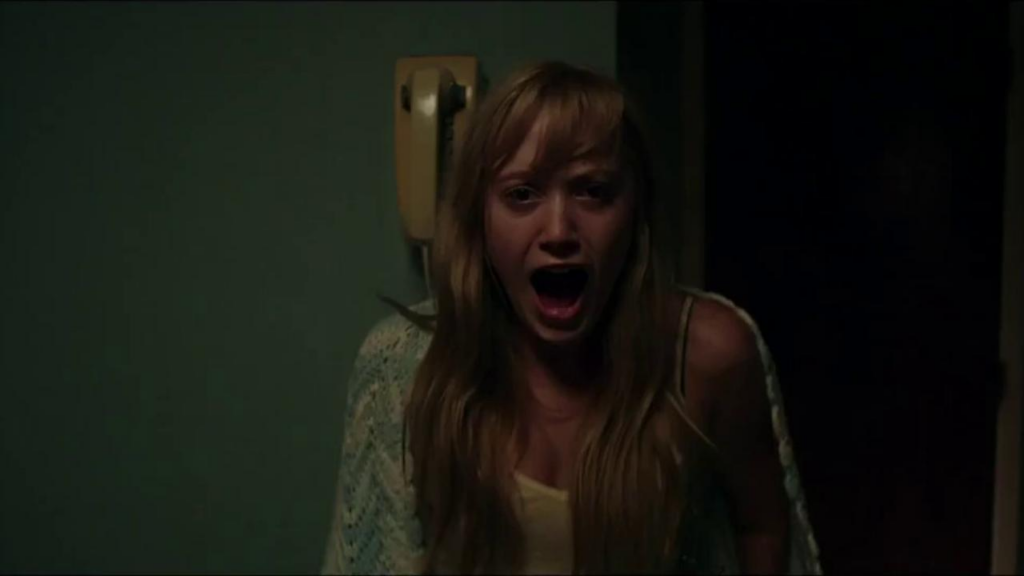
But it’s back in that moment of silence, suspended in midair, no oxygen, no escape, that we experience true terror. Then concrete. Oh Fuck! Rating: 10 out of 10
Edited by Olga Tchepikova-Treon