
|Nicole Rojas-Oltmanns|
The Craft plays in glorious 35mm at the Trylon Cinema from Sunday, October 25, through Tuesday, October 27. For tickets, showtimes, and other series information, visit trylon.org.
“Now is the time, now is the hour, ours is the magic, ours is the power.” The first lines of The Craft (1996, directed by Andrew Fleming) focus us on the goal of the film’s creators, empowerment. Instead of a cute coming-of-age drama, we get sexism, racism, classism, depression, addiction, sexual assault, and domestic violence. All things that actually affect young women.
The film’s music echoes their plight. 8 of the 15 songs are sung by women, not enough, but over half. The lyrics frequently harken back to the four elements, the forces they inhabit, and the realities of women. Jewel’s song, “Under the Water,”, includes the lyrics: “I’ve decided to hear who we will become / Wanna lay down in the water, go back to where I’m from.” Even Connie Francis’s love song,”Fallin‘“, plays from a jukebox in the new swanky apartment inhabited by Nancy and her mother, saying, “Like a leaf falls from a branch / Like a rock slide avalanche / Like the rain on a stormy day / I never thought I’d fall this way.” And Siouxsie and the Banshees’ “Sick Child“, “ Melancholia colliding out of mind / In a silver swirl I take a lungful in / Blow a fistful out.”
Ralph Sall, the film’s music supervisor, produced 10 of the 15 featured songs. These 10 songs make up the first 10 tracks of the soundtrack album. Now we know why Love Spit Love’s version of How Soon is Now? made it into the film instead of The Smiths’. The 11th and 12th songs were produced by Mark Waterman and Bryce Goggin, respectively.
The 13th and final track is part of the original score by Graeme Revell. The score is ethereal, creepy, and a little campy, and does what a score ought to, in my opinion: make the film cohesive and full without distracting from it. A really good score can, of course, transcend, elevate, and become iconic. This one is not one of those.
If you are doing the math, you’ll notice that three songs are left out of the soundtrack: “Sick Child” by Siouxsie and the Banshees, “Fallin'” by Connie Francis, and “Glory Box (Scorn)” by Portishead. The songs were not included on the soundtrack due to issues with securing rights from the record labels.
Portishead released the trip hop song, “Glory Box (Scorn)”, as well as two other remixes on a single, Glory Box. This song and the scene it accompanies are forever connected to my memory of the film.
This song appears later in the film and mirrors the theme of empowerment shown in the opening with Nancy, Rochelle, and Bonnie chanting about the time for power. We meet Sarah right after as she is moving from San Francisco into a house in LA with her father and stepmother. She has a series of negative encounters with peers and calls Chris, her love interest, an asshole during their initial conversation. It is his cruelty that leads her to join the coven.
On their first night out together, the four young women kill a mentally ill man who has been stalking Sarah with snakes and scary prophecies. As an audience, we are conflicted about this death. Was he really going to hurt her? She is scared at first, but sees the coven as a way to take control when everything feels out of her control.
Leading up to their first circle and spells, we are shown vignettes of each of their lives. Rochelle deals with the overt racism of her classmates. Scenes cut from the film also show her having well-off parents with overly high expectations, which is why she is on the diving team. Burn scars cover Bonnie’s back. Sarah has experienced depression, loss, nightmares, and attempted to end her life. Nancy lives in a dilapidated trailer home with an alcoholic mother and unsavory stepfather. Because these are shown in succession, we think they all have it bad. But Bonnie and Sarah are shown in safe comfortable homes with caring parents. Rochelle’s home is shown later in the film and the feeling is also safe and comfortable. Nancy stands out from the beginning.
Their initial spells are rather innocent. Rochelle asks, “for the ability to not hate those who hate me.” Sarah asks, “to love myself more, and to allow myself to be loved more by others, especially Chris.” Bonnie asks, “for the power to be beautiful outside as well as in.” Then we get to Nancy, who asks for “all the power.” One of these things is not like the others.
As a natural witch, Sarah’s spell works the following day at school. At first, she has fun with Chris’s undying love for her and obedience, but eventually realizes that for women, love comes at the cost of freedom and power. She tries to find a way to undo the spell, but can’t.
Bonnie’s scars disappear. Rochelle gets revenge on her racist classmate and succeeds on the diving team. Nancy comes into money by killing her stepfather. We have fewer conflicted feelings about this guy in a very “Earl had to die” sort of way. This further pushes Nancy apart from the others. She takes things further than they do.
Nancy and her mother buy a swanky apartment with Ray’s insurance money. Her mother is still an alcoholic, and their relationship is toxic. Nancy still wants more power over her life.
Their second circle seeks to invoke the spirit. Nancy slips and says, “Hear me,” at the end of her corner’s request. The others correct her, “Hear us.” A storm follows and Nancy walks on water. After this, Sarah is uneasy about continuing the practice of magic. Rochelle and Bonnie seem to be under Nancy’s spell.
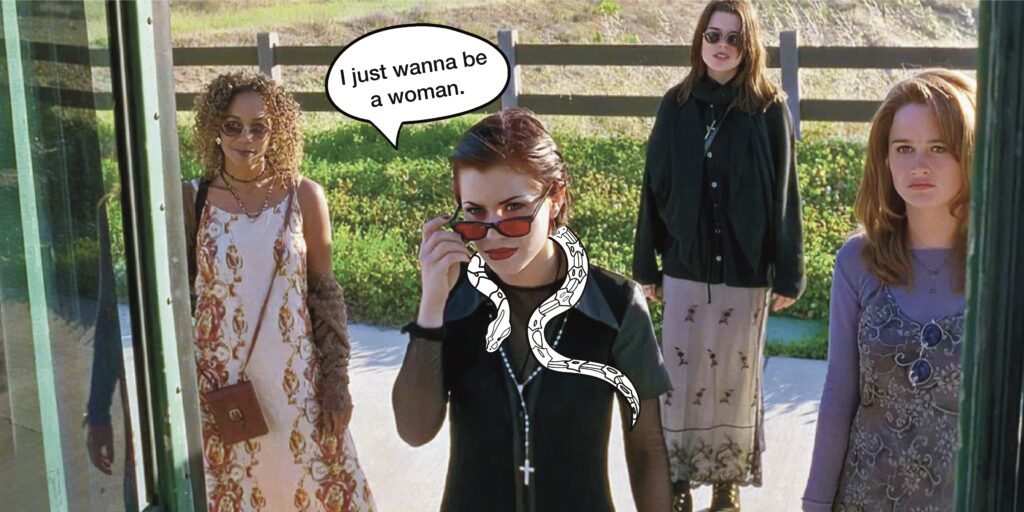
After Nancy continues to take things too far with the coven, Sarah agrees to go on a date with Chris. This is where the Portishead song plays. Shortly into the date, he says, “Now that I have you, I’m not letting go,” and tries to touch her. Coming on too strong for Sarah, she asks him to take her home. He refuses and she gets out of his car. As the music intensifies, he follows her and attempts to sexually assault her. Right after she knees him in the parts and pushes him down a hill, we hear the lyrics, “I just wanna be a woman.”
This is a huge turning point in the film and the moment I remember most. Sarah takes the power away from Chris by using her own power, and the sad realization that just wanting to be a woman is often too much to ask.
It is the tipping point for Nancy, who decides to take revenge on Chris. He tells her she is just jealous of Sarah. Nancy is not just jealous of Chris’s love of Sarah; she is also jealous of her natural powers, and everything she has that Nancy has not. Chris is the third man killed in the film. Even though he has made terrible choices, we do have some conflicted feelings about this. They put a love spell on him. The results of which were an extreme debilitating obsession with Sarah. Once he is in love with her, she no longer wants him. On the other hand, his actions are unacceptable throughout much of the film. But does he deserve to die?
In the end, Sarah retains her power. Bonnie’s magic is gone, but not the newfound sexual power of her body. Rochelle’s magic is also gone, but her revenge caused a change in her racist classmates. Nancy was arguably the worst off at the beginning and the end of the film. As with the fate of too many women throughout history, we end with Nancy tied down and being injected with a sedative in a mental institution.
Edited by Finn Odum