
|Andrew Neill|
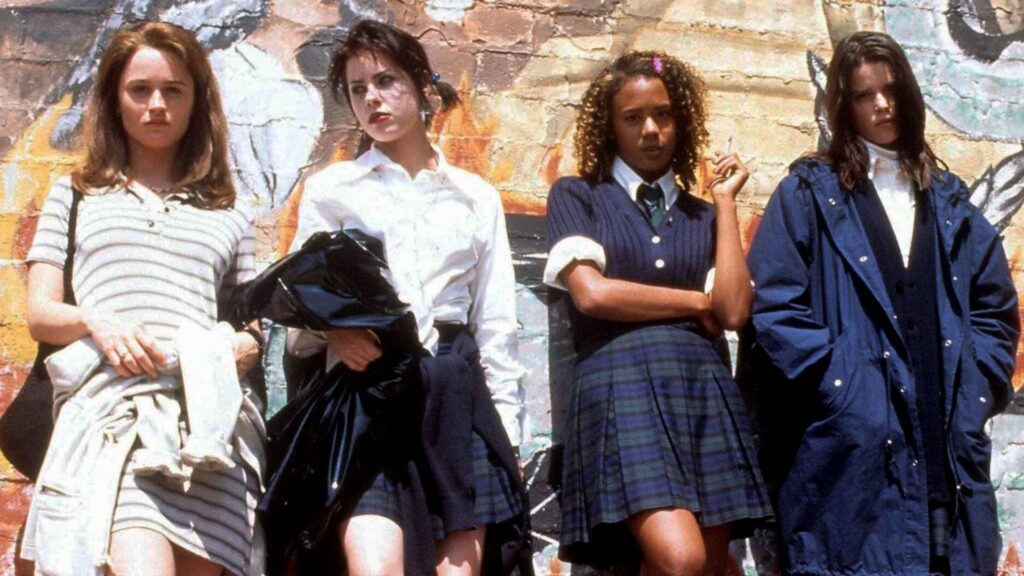
The Craft plays in glorious 35mm at the Trylon Cinema from Sunday, October 25, through Tuesday, October 27. For tickets, showtimes, and other series information, visit trylon.org.
Content Warning: This piece discusses suicide and bullying, and references rape and domestic abuse.
True magic is neither black nor white. It’s both because nature is both. Loving and cruel all at the same time.
This line, spoken by Assumpta Serna as the enigmatic shopkeeper Lirio, may be explicitly about magic and nature, but it extends to the central focus of the movie around it: teenage girls.
Early on in The Craft, four teenage girls sit in a circle casting spells, but they’re actually confessing their deepest desires to one another. Robin Tunney plays Sarah, the new girl in school, who wants the affection of a boy, in spite of him recently spreading rumors about her. Neve Campbell plays Bonnie, the most reclusive of the group, who wants to rid her body of burn scars and be beautiful outside as well as in. Rachel True plays Rochelle, the only black girl in their overwhelmingly white school, who curses a racist bully. And the fiery Fairuza Balk plays Nancy, the wild leader of the group, who goes bigger. She asks for all the power of Manon, the pagan deity they worship. As the girls explicitly or implicitly reveal their core vulnerabilities, their friendship deepens along with our endearment to them.
And then they turn on each other and all hell breaks loose. The confessions made in peacetime become ammunition when it’s war. The Craft represents a mean streak that cut through teen movies of the 90s. Many of its class depicted a teen culture that was nastier, more sarcastic, and more nihilistic than its predecessors. But The Craft stands out for its sensitivity underneath the frank, confrontational surface, which makes its ultimate cruelty even sharper.
The Craft came out in May 1996, but it was overshadowed by a cultural behemoth released that Christmas—a movie that, to this writer, defined Hollywood cinema for the decade—Wes Craven’s Scream. The teenage savagery that The Craft depicted to mixed reviews and modest returns went mainstream with Scream. That movie’s writer, Kevin Williamson, would go on to be the loudest voice in teen genre movies of the era, particularly horror, with additional works like Scream 2, I Know What You Did Last Summer, and The Faculty. He also created the far soapier, yet generational teen drama for TV, Dawson’s Creek. Williamson’s writing for the silver screen is knowing and edgy. If Tyler Durden dropped in and asked Williamson, “how’s that working out for you, being clever?”, the writer would answer, “pretty great, you fuckin’ figment.” He proliferated and profited from the flagrant use of the ironic and metatextual, cuing the groans of many to come before and after.
The world of teen cinema that The Craft and Scream entered into was not overly sincere or sanded down. The 80s were a renaissance for the teen movie, led by the now canonized works of writer/director John Hughes. Sixteen Candles, Pretty in Pink, and The Breakfast Club were and continue to be touchstones for audiences and filmmakers alike. (One might argue that The Craft is a movie where everyone is Ally Sheedy’s character from The Breakfast Club and also a witch.) Hughes’s movies have largely pop sensibilities—he is, at his core, a comedy writer—but his movies endure because they face many real pains and insecurities of teendom. There’s an emotional intelligence in the work that The Craft would carry forward.
The true darkness and alienation would blast forth onto the scene with Michael Lehmann’s Heathers in 1989, written by Daniel Waters. As a work of satire, Heathers grabs onto every third rail it can get its finely manicured fingers around. Suicide, shootings, bomb threats, date rape. It’s a high school popularity contest from hell. Whereas Hughes finds common ground in the pain and confusion of teendom, Lehmann and Waters find ugliness and hate. The love that fans have for Heathers isn’t a feature of the film itself. It lies in the recognition we find in its darkness. Our culture may do its best to repress or ignore these ugly feelings, but they are very, very real.
The Craft blends Hughes and Heathers and adds shades of the supernatural. Before the leather-studded gloves come off, the movie takes the time to build up where the four girls making up this coven come from. Unlike many teen films before and after it, The Craft centers on social outcasts rather than the popular kids. Class and race dynamics are out in front.
Rochelle is openly bullied by popular girl Laura for being black. Laura mocks Rochelle’s curly hair in front of others in the locker room, which inspires Rochelle’s curse to cause Laura’s treasured blonde locks to fall out in clumps. Despite this victory over her enemy, Rochelle continues to carry insecurity around her hair with her. In a later scene, Sarah changes her hair color using a glamour spell, and Rochelle eagerly asks Sarah to make her a blonde.
While her friends live in spacious McMansions, Nancy is laden with shame and anger attached to her poor, broken home. In glimpses of Nancy’s home life, we see how her mom and stepdad see her as an inconvenience, if they pay her any mind at all amid their constant arguing. After the spellcasting scene, a spat suddenly turns physically abusive. As her stepdad goes to hit her mom, a surge of Nancy’s power causes him to have a fatal heart attack.
This brush with power feeds Nancy’s hunger for more. She convinces the girls to perform an invocation ritual on the beach in a standout sequence. As the camera revolves around them, the ocean surf washes up, and storm clouds rumble overhead, lightning strikes Nancy, and she is imbued with the powers of Manon. This begins a rift between Nancy and Sarah, the latter of whom believes Nancy has gone too far. Nancy and the other girls are enjoying the power trip, so they decide to remove Sarah from the equation.
This is where the movie really lets ‘er rip. Nancy, Rochelle, and Bonnie, who have opened their coven to Sarah and given her space to share her deepest physical and emotional wounds, now use that pain against her. They invade Sarah’s dreams and manifest her nightmares in the waking world. Sarah’s house fills with snakes, spiders, and other creepy crawlies. (A shot of maggots burping out of the toilet is especially gag-inducing.) They try to convince her that her family has died in a plane crash with a news broadcast on TV. But the most vicious part is how they open up the cuts on her wrists from when she attempted suicide. Nancy takes things further by accusing her of killing her mother, invoking the very reason Sarah attempted to end her life.
This sequence goes hard. The cruelty would be irredeemable if the movie hadn’t established the girls’ experiences before it. Whether due to their race, class, or physical appearance, society around them has deemed them unwanted. For Nancy, that extends into the home, so the only ground she has to stand on is her friendships. All this makes their rejection of Sarah all the more tragic. These girls, who understand how important friendship is as the foundation for their lives, pull that foundation out from under Sarah’s feet.
It hurts because we’ve all been there. We’ve all felt powerless. Our teenage years are a cataclysmic time when our bodies and minds descend into chaos. We’re not children, but we’re not adults either, so we don’t have autonomy. It can make you feel lost and useless. Now hand that person with the rampaging brain and lack of compass all the powers of a pagan deity and what do you expect to happen? Grace and restraint? Fuck no. You get absolute carnage. After years of rejection, Nancy, Rochelle, and Bonnie finally get to dominate. Unfortunately, due to the myopia of youth, they turn it on their friend who only showed some reservation about wielding such awesome power without restraint.
Sarah eventually does some invocation of her own and brings the magical smack down on Nancy and the girls. Rochelle and Bonnie lose their powers and Nancy ends up in a mental hospital, but it’s a pretty gnarly way to wrap things up. In the end, the collective cruelty of three teenage witches can only be crushed by one more powerful teenage witch who turns their cruelty back on them. To defeat the mean girls, you must become the meanest girl. It’s harsh, but hey! That’s the 90s, folks!
In addition to the works of Kevin Williamson, the mean streak in teen movies of the era continued into the late 90s and early 2000s. Two highlights came in ‘99. First, Drop Dead Gorgeous, the shot-in-Minnesota satire of teen pageant culture, which is absolutely diabolical and hilarious. Also, 10 Things I Hate About You, a modern spin on Shakespeare’s The Taming of the Shrew that is essentially wall-to-wall teens being mean, but it doesn’t matter because everyone’s so hot and they live in Seattle.
But ‘99 also marked a pivot point. The teen movie began evolving into the raunchy comedy with American Pie, ushering in a resurgence of late 70s/early 80s snobs vs. slobs mess-arounds. This kind of oversexed, gross-out comedy was huge at the time but has very little lasting value. As someone who 1. identifies as male and 2. was a teen at the time, I want you all to know how bad I feel about how much I laughed at and quoted these movies. I am due a lifetime sentence of atonement. Please, drag me.
By the mid-aughts, the teen movie as it was known had fizzled to an ember. Hollywood became obsessed with intellectual property, and young adult franchises like Twilight and The Hunger Games became the dominant force. Few recent films have harnessed fiery anger the likes of The Craft, but faint, promising glimmers have emerged.
Do Revenge from 2022 is a candy-colored romp with a pitch-black heart. It has a Strangers on a Train-like setup, with two girls swapping vendettas to avoid repercussions. It may look like Clueless on the surface with its wild costumes and lavish rich-kid digs, but its infernal machinations, which consist of a sex video release, mass drugging, and non-consensual outing, more closely resemble Heathers.
Growing closer to the vine is Forbidden Fruits, about an obsessive, insular coven of young women who work at a trendy clothing store in a mall. This one may not have the explicit magic of The Craft, but it does plumb the darkness of toxic friendships. Lili Reinhart plays the leader of the group who forces her will upon the others to a bloody breaking point. It’s a movie that teeters on the brink of camp, but absolutely thrives on the playground of the malicious. It delights in squeezing as much juice as it can out of its characters’ pettiness and codependence.
Still, these progenitors lack the emotional core that defines The Craft as something extra. Being mean on screen doesn’t have to be flattened into a nasty romp or brutal exercise. When that anger is rooted in character, it carries experience and enables catharsis. We all want to wield a little power over others. The Craft allows us to channel that desire through the wild eyes and devilish grin of the singular Fairuza Balk.
Edited by Finn Odum